We screen, diagnose, design and deliver AI solutions that improve your current workflows. Then we help you build your own research and development engine to improve your product, so the AI advantage belongs to you, not to your vendors or competitors.
Nine products we built, running today, more to come.
Mining, property, health, energy, ocean and documents. Each one is open in your browser, and each one can run on your own servers.
geo.nlp-tlp.orgOpen
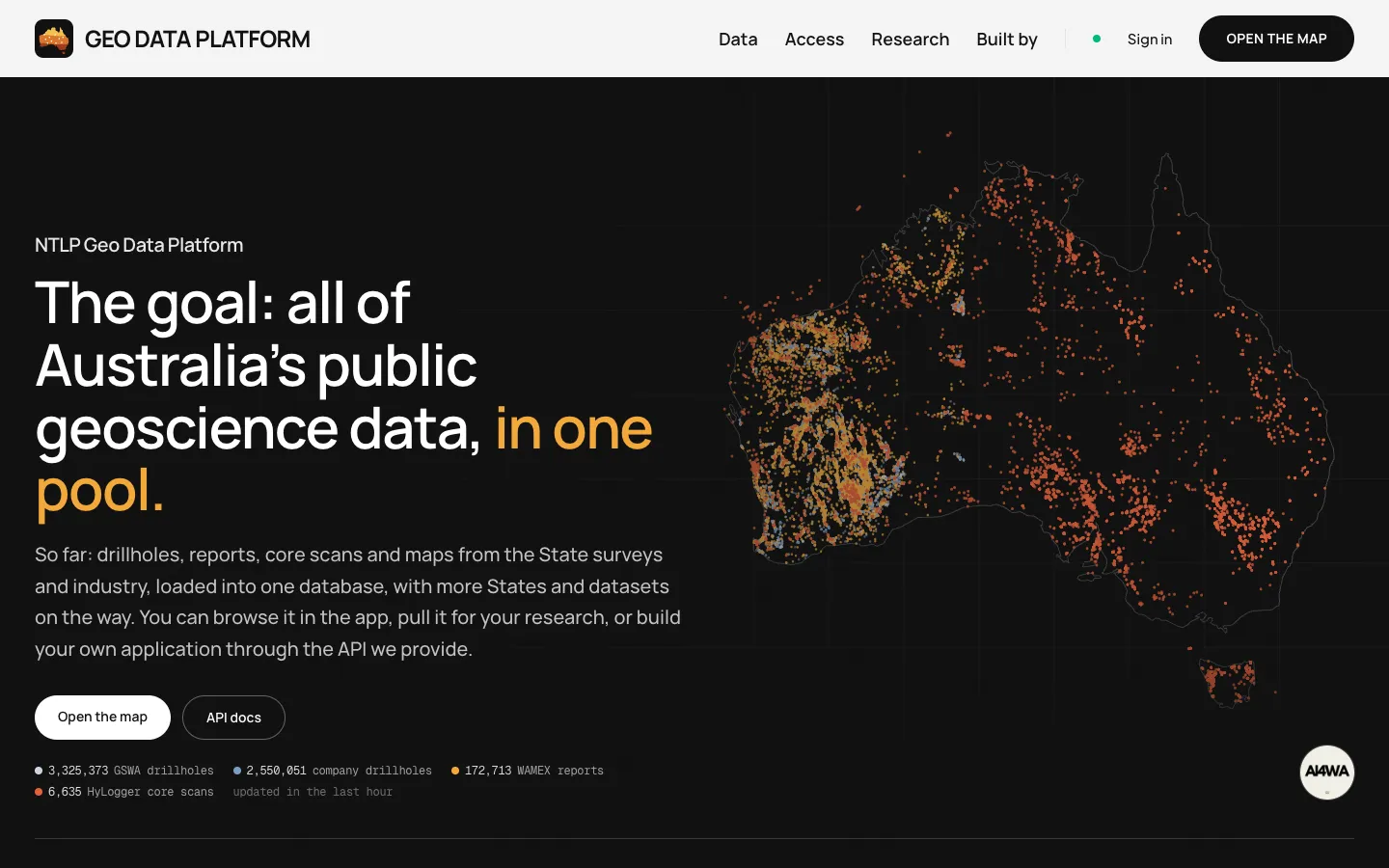
Australia's public geoscience data in one pool: millions of drillholes, reports and core scans.
How we work.
Two layers. First we put AI into the work you already do. Then we build the research and development that makes your product hard to copy.
1
Put AI into the work you do today
Four steps. You can stop after any of them, and each one leaves you something to keep.
Swipe through the four steps
1
AI workflow screening
Where AI helps, and where it doesn't
We review how your team actually works, task by task, and test each workflow against what today's AI can reliably do.
You get
A report rating each workflow: automate, assist, or leave as is
The reason, effort and risk for each rating
A short list of concepts worth prototyping
Typically 2 to 4 weeks, fixed price
2
Concept design and proof of concept
Prove it on your data
We design the solution and build a working prototype on your real data. Success measures are agreed before we start, so the result is a clear yes or no.
You get
A concept design and a prototype your staff can try
An evaluation against the agreed measures
A go or no-go recommendation with build cost
Typically 4 to 8 weeks
3
Production development
Build it properly
We turn the prototype into reliable software, connected to the systems you already use and deployed in your cloud or on your own servers.
You get
Production software, source code and documentation
Integration with your systems and sign-in
Security review, logging and access controls
Typically 2 to 6 months
4
Support and improvement
Keep it working
AI systems drift as data and models change. We monitor quality, update models, and add features as your team asks for them.
You get
Ongoing quality monitoring and evaluation
Model and data updates
A named engineer who knows your system
Monthly, scaled to use
Step 1 gives you a report like this
An example for a Perth engineering consultancy. Every workflow gets a rating and a reason.
2 automate2 assist2 leave as is
Workflow
Rating
Why
Copying figures from supplier quotes into estimates
Automate
Repetitive extraction from PDFs, and every figure can be checked against the source
Finding past project reports on similar sites
Automate
Search across the archive with the source page cited
Drafting site inspection reports
Assist
AI drafts from photos and field notes; the engineer reviews and signs
Checking tenders against specifications
Assist
AI flags gaps for a person to confirm; the cost of a miss is high
Monthly safety statistics
Leave as is
Already automated in your reporting system
Client negotiations
Leave as is
Relationship work with little for AI to add
2
Build an R&D engine you own
Anyone can buy the same AI models. What competitors can't copy is a method built on your data, for your problem. Our dedicated research team builds it with you and puts it into production.
What we build
Custom models and methods, tested with research rigour
Research on your own question, published if you want
Benchmarks of vendor AI tools on your data
How it can be funded
Records that support R&D Tax Incentive claims
Research collaborations with suitable research groups
Exploring research grants together and preparing the applications
WA holds decades of public exploration data, but turning it into a drilling decision still takes specialists weeks. We built the platform that puts it in one place, and the models that read it.
Grey dots are geochemistry samples. The research layer adds modelled prospectivity and the deposits discovered after 2020 that we used as a blind test.
Data engineering foundation
One spatial database of GSWA geochemistry, geophysics, mapped geology, structure and drillholes
Mirror of NVCL HyLogger drill-core scans, plus uploads of a company's own samples
Neighbourhood queries fast enough for interactive maps, about 30 ms over 10 km
Open data clients and an agent interface so AI assistants can query it directly
Research capability
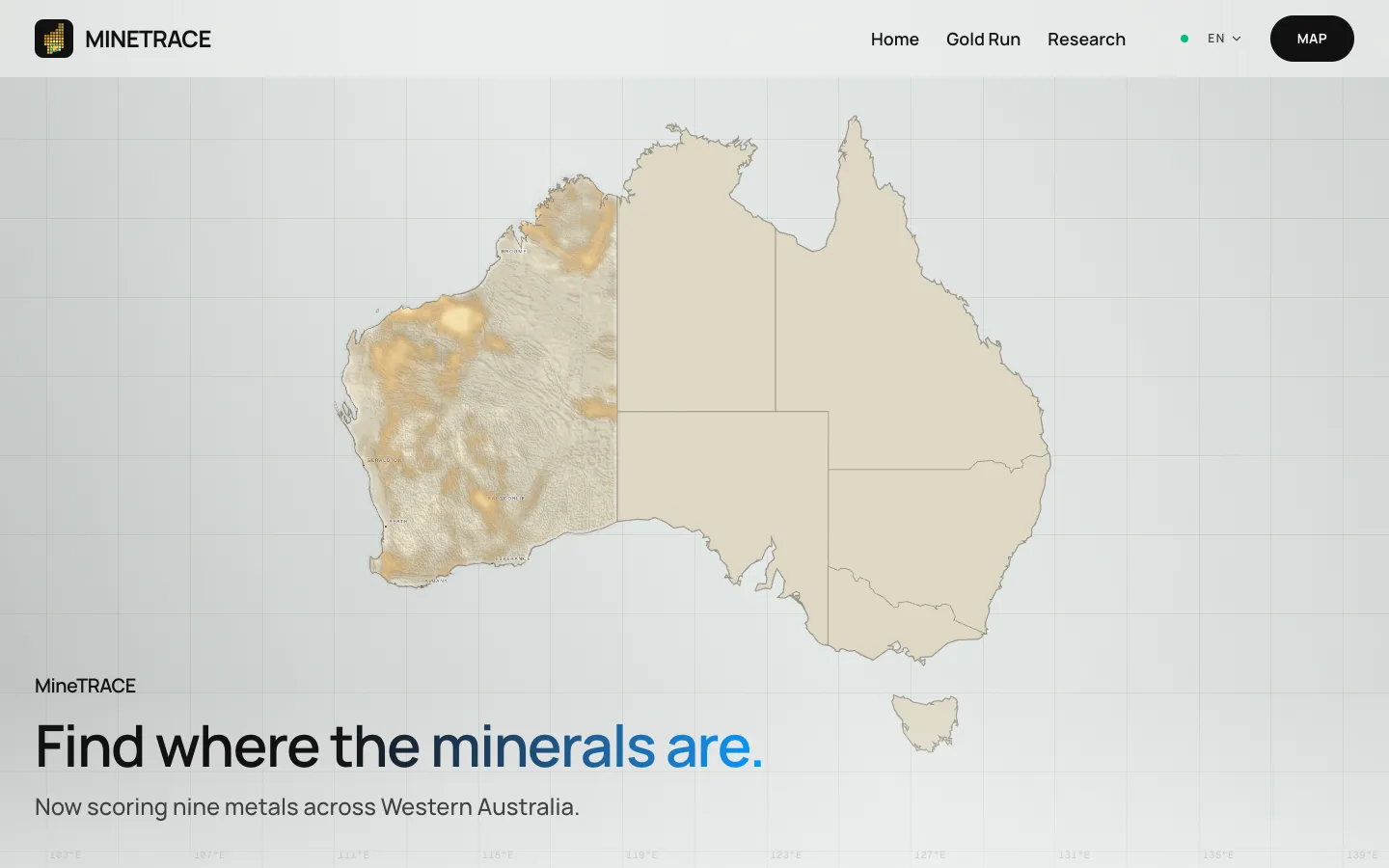
Prospectivity scoring for eight metals, with the evidence behind every score
Blind-tested against deposits discovered after 2020
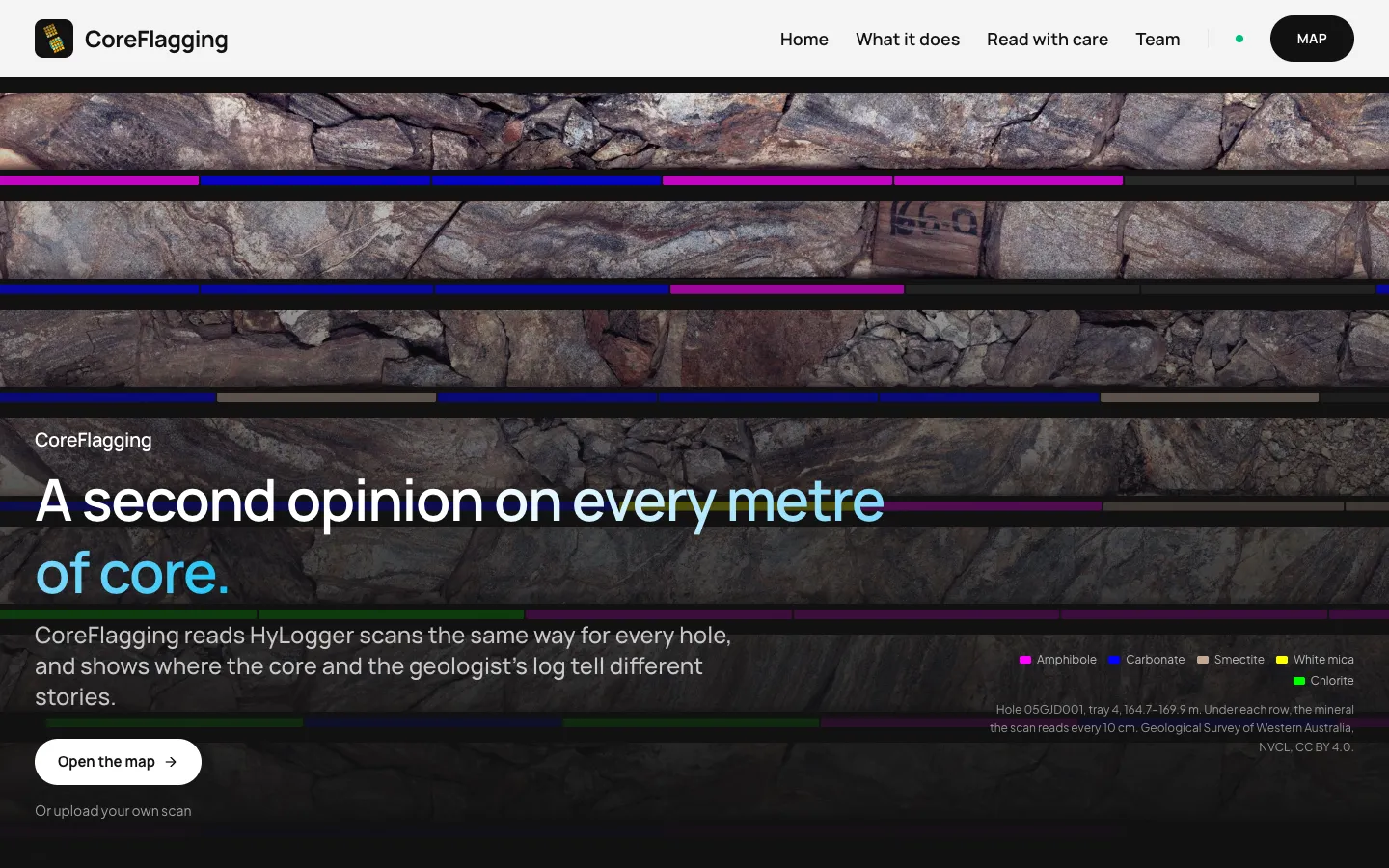
Automatic core logging, unusual intervals and gold likelihood per metre
Search for similar core anywhere in the State
GeoThought: geologists' questions asked of every page of the WAMEX reports, each answer kept with its quote and its place on the page
For explorers, mining services companies and geological consultancies.
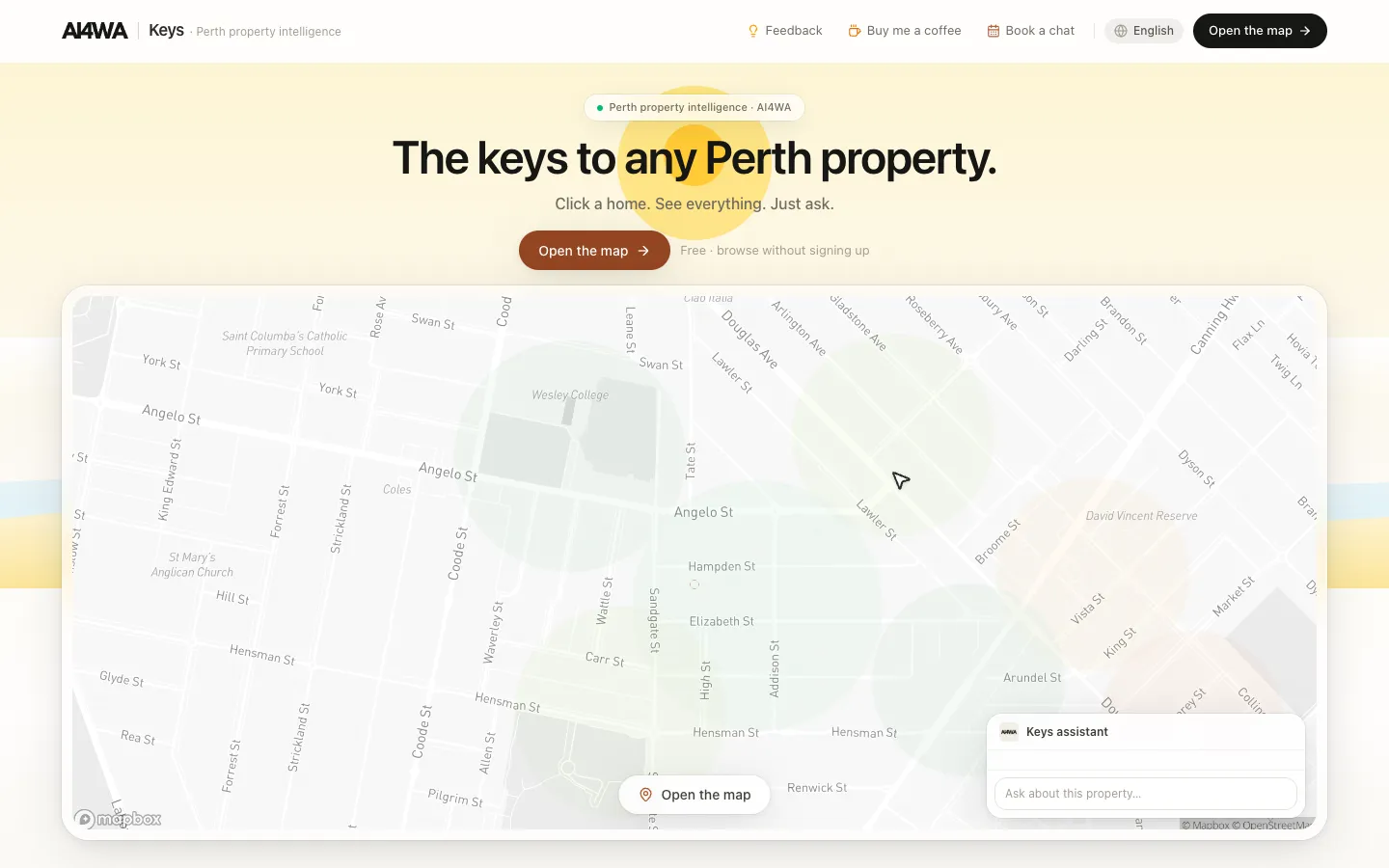
Everything a buyer or planner needs to know about a Perth block is public, but it sits with more than a dozen agencies. We joined it at the level of each parcel.
Each block is a parcel coloured by zoning, with flood and bushfire overlays. The research layer traces the view from one block to the ocean.
Data engineering foundation
Every Perth-metro parcel linked to zoning, R-codes, bushfire and flood mapping
Schools, crime, Census demographics, public transport and powerlines on the same parcel
Development applications synced nightly from state planning registers
Built entirely from open WA and ABS data, with licences tracked per source
Research capability
Ocean-view score for each parcel, computed from 1 m elevation models
Urban heat estimates from Landsat surface temperature
A chat assistant that answers only from the parcel database
For agents, developers, valuers, planners and local governments.
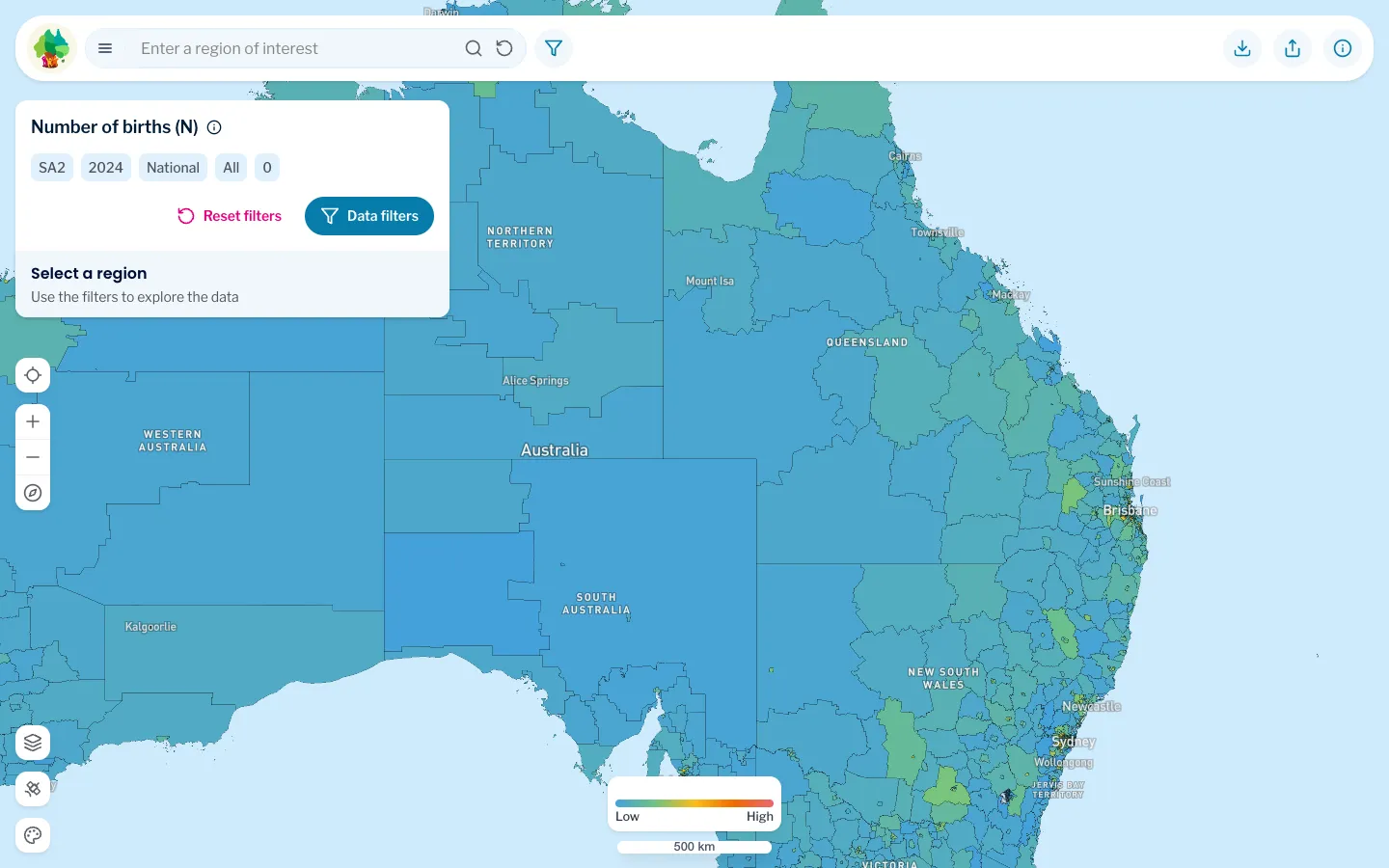
Policy teams need to compare child wellbeing across areas, but the indicators come from many agencies in different shapes. We built the national atlas that brings them together.
Each cell is a statistical area. The research layer matches a plain-English question to an indicator and shades the map.
Data engineering foundation
About 3,600 wellbeing indicators across seven domains, from learning to safety
Harmonised to every SA2, SA3, SA4, LGA and state in Australia
Interactive maps for each indicator and area
Research capability
An assistant that finds the right indicator from a plain-English question and opens the map
Measured accuracy of AI database answers on the atlas, using our own database benchmark
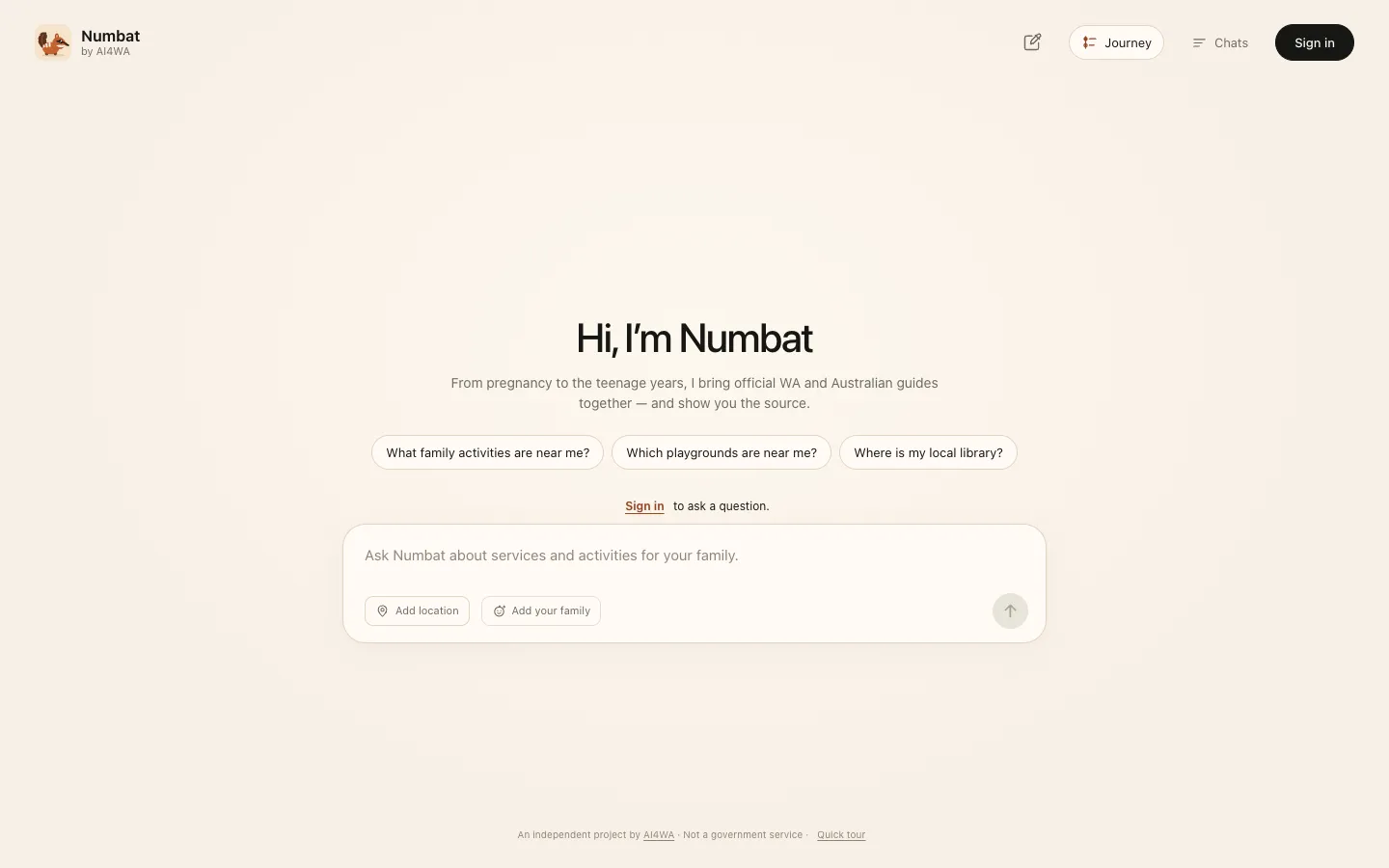
Numbat, a front door for WA parents: ask in plain words, get answers linked to official council and government pages
For government agencies, health services, researchers and community organisations.
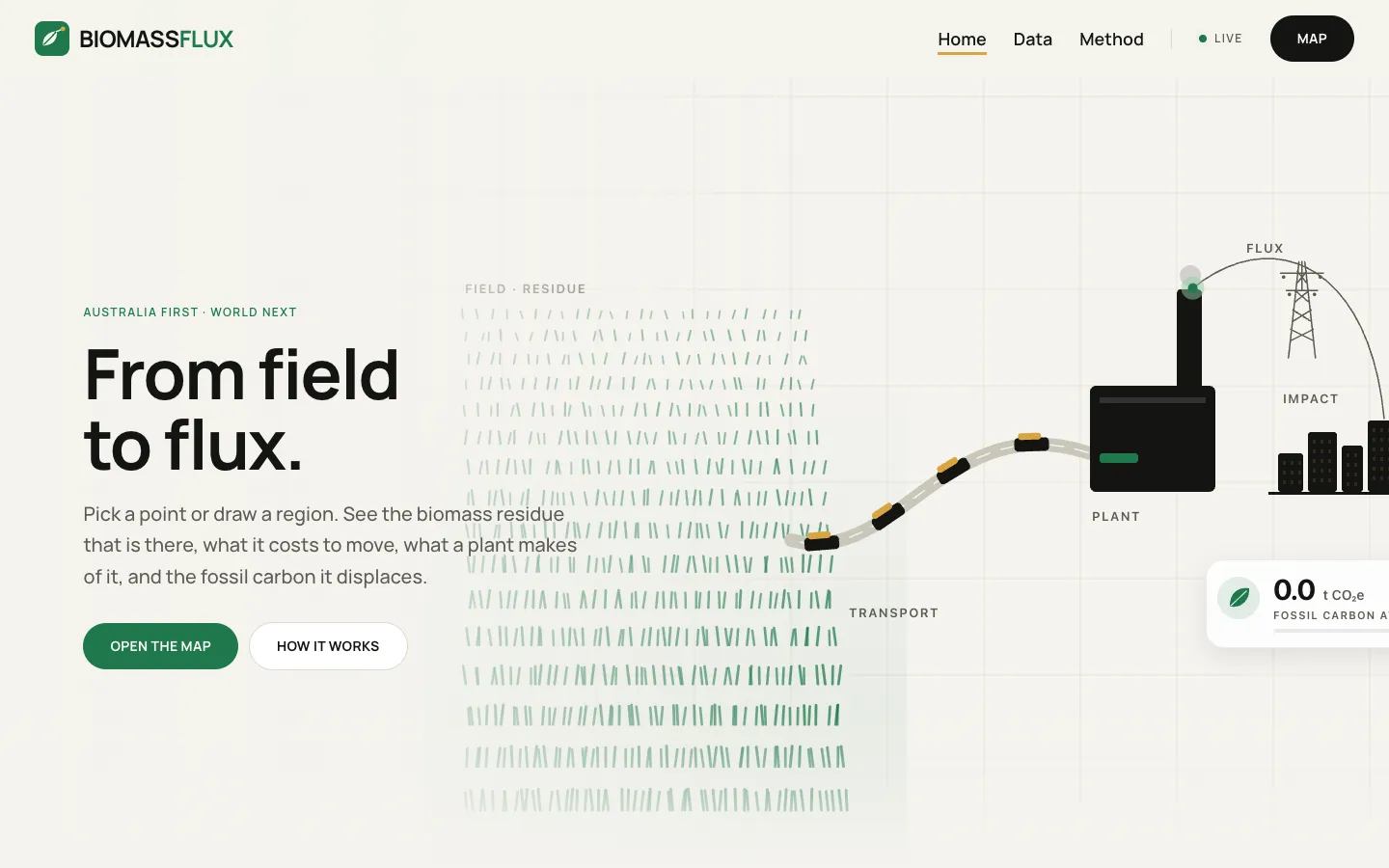
Farm, forestry and food-processing residues can replace diesel and coal, but only if the supply, haul distance and plant size add up. We built the platform that does that sum for any place in Australia.
Dots are residue sources sized by annual tonnes, squares are processing sites. The research layer routes supply within a radius to a candidate plant.
Data engineering foundation
State biomass residue assessments harmonised into one national table by region and feedstock
About 20 million dry tonnes of residue a year mapped for WA alone
Wood processors, wineries, feedlots, biogas and waste sites on the same map
Standing biomass from satellite and national carbon-accounting rasters
Research capability
A calculation engine following the CSIRO and NSW BioSMART methods, tested against their formulas
Transport fuel, cost and emissions for each haul, by road route
Six end uses compared side by side: power, co-firing, hybrid solar-biomass, industrial heat, biochar and liquid fuels
Carbon abatement for each scenario
For energy developers, miners planning to decarbonise, agribusiness and councils with organic waste.
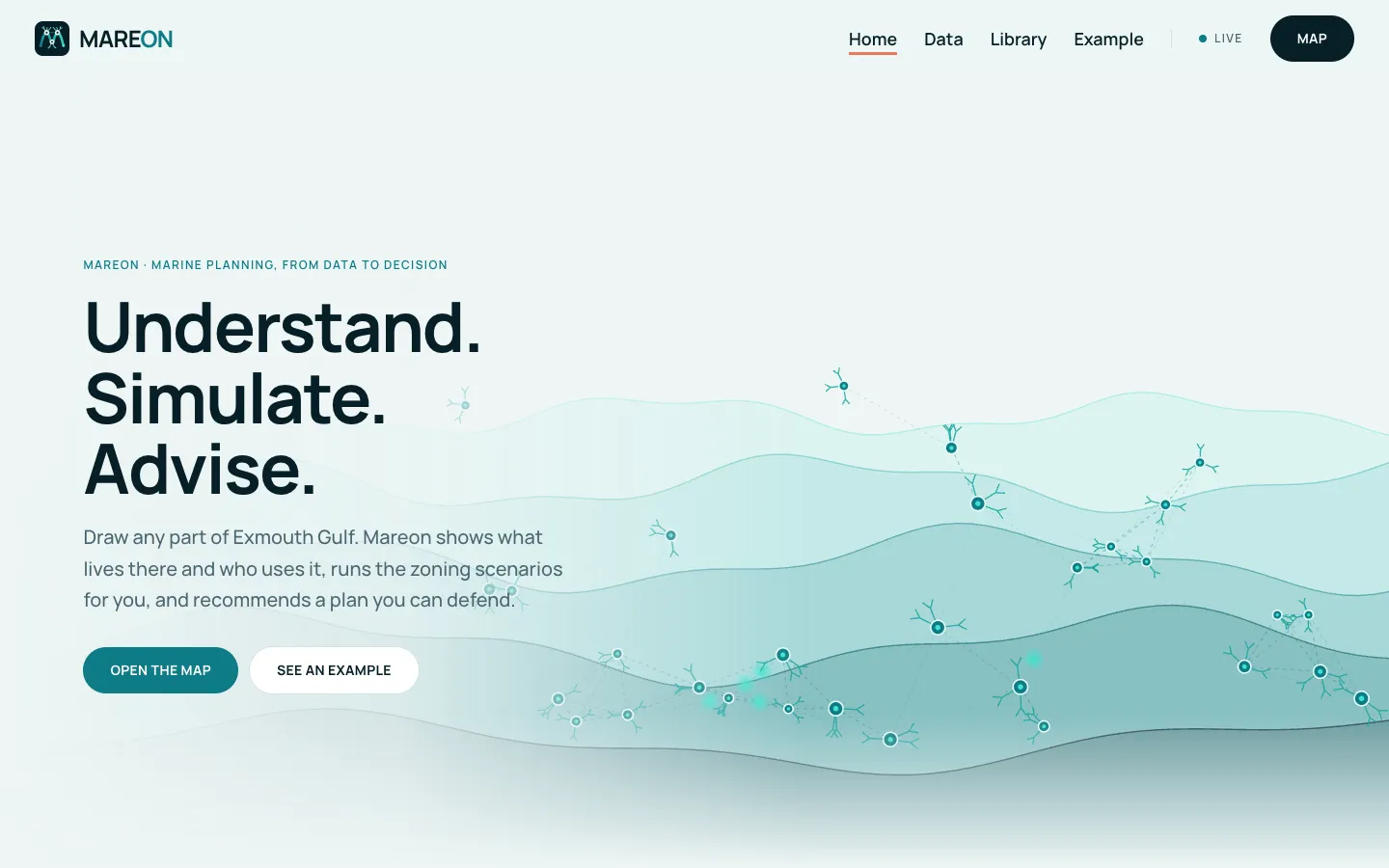
Habitat maps, leases, fishing grounds and research papers sit with dozens of agencies and consultants, so deciding where a marine sanctuary should go takes months. We built the platform that puts them on one map and runs the planning calculations for any area you draw, starting with Exmouth Gulf.
Habitats, leases and a trawl ground on one map of a gulf. The research layer runs the optimiser over the planning grid and proposes which units to protect.
Data engineering foundation
About 90 spatial layers of habitats, wildlife areas, leases, fishing grounds and heritage sites in one spatial database
Every dataset with its source, from one bay up to state, national and global layers
A library of about 600 research papers, searchable down to the page
Built on the Exmouth Gulf database Oceanwise Australia made for the Protect Ningaloo campaign
Research capability
Gap analysis of 42 conservation features against their targets for any area you draw, in under a second
Marxan, the standard marine park optimiser, on a grid of about 20,000 planning units, in seconds
About 20 zoning options tried automatically, each kept with its inputs so anyone can rerun it
A recommended plan with its reasons, checked against the 30% protection target
For marine planners, environmental consultancies, coastal councils and offshore operators.
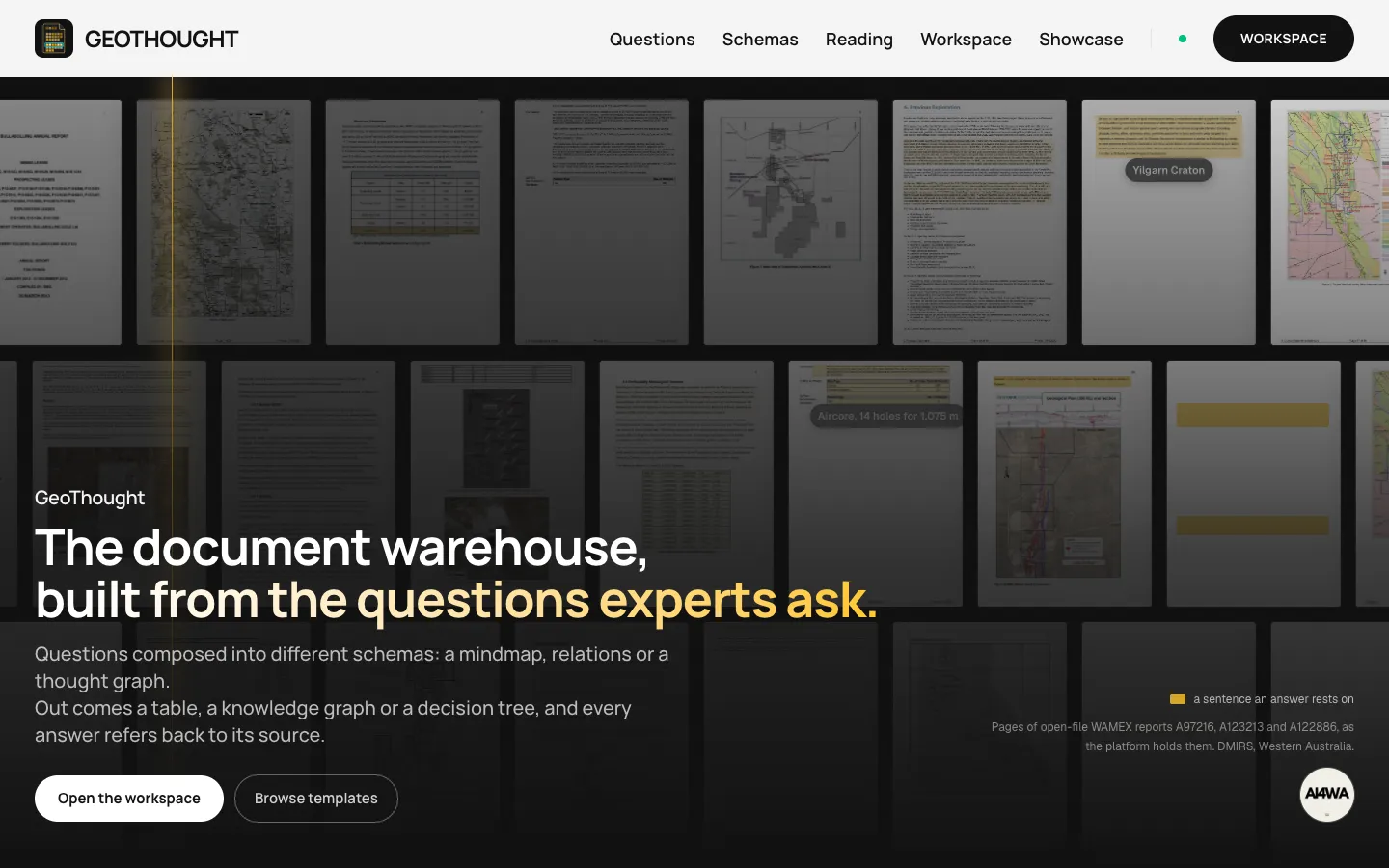
Most organisations keep their knowledge in PDFs: reports, contracts, scanned maps. We turn archives like WA's mineral exploration reports into data people can search and question.
A scanned report page with its text, table, figure and formula detected. The research layer turns them into linked records and a georeferenced map.
Data engineering foundation
A pipeline that reads text, layout, tables, formulas and figures from scanned documents
Extracted facts stored in a structured warehouse, each linked to its page
Applied to the WAMEX exploration report archive
Research capability
Automatic georeferencing of scanned geological maps
Extraction of places and dates from free text
Testing whether AI answers from a database are right, across 220 databases
GeoThought: a warehouse built from the questions experts ask, arranged as a comparison table, a knowledge graph or a decision tree, with every answer traced to its source
Numbat: council and government web pages and PDFs kept current in a checked warehouse, so parents get answers linked to the official page
For any business with an archive of reports, contracts or records searched by hand.
Every application runs entirely inside your network.
All the platforms on this page can be installed on your own hardware with open-weight models. Nothing is sent to an external AI provider, and they keep working when the internet doesn't. For many WA companies this is the condition for using AI at all. More on private AI.
Mining
An exploration platform that keeps your data in the building
Explorers hold their most sensitive data before it is announced: new assays, core scans, target maps. With an on-premise install, GeoPlatform, MineTrace and CoreFlagging sit on your server next to that data. Public geoscience flows in; your results and the scores built from them stay with you.
Unannounced results stay off third-party services until you report them
Works at remote sites with poor or no internet
Your own samples are scored alongside public data, privately
Voice
A voice assistant with no cloud
A device in the room listens for its wake word locally. A server on your network does speech recognition, the language model and the reply voice.
Measured response times
First word from an 8B model on a local GPU server
43 ms
Same step with a small cloud model
720 ms
Same step with a large cloud model
2,400 ms
From end of speech to the reply starting
320 to 434 ms
Local is not only more private, it can be faster too.
Prototype
The team and platform behind it.
Your project doesn't start from a blank page.
People
Experienced developers and researchers
Engineers who have shipped production software, working alongside PhD researchers in machine learning, language, geospatial data and speech.
Peer-reviewed research, and the evaluation habits that come with it
Full-stack delivery: data pipelines, models, web apps, deployment
Based in Perth, on-site with your team when it helps
Applications
Where we've already built, and more to come
Proven parts we reuse, so your project starts ahead.
The infrastructure is already in place, so we start prototyping your idea from the first day.
Spatial data platforms with WA public data already loaded
GPU servers for running models locally
A deployment setup that installs any of our applications on your own servers
Edge devices for AI on site and in the room
Questions we often hear.
If yours isn't here, just ask us over a coffee.
We don't know where AI fits in our business. Is it too early to talk?
No, that is the most common starting point. A workflow screening exists for exactly this. We look at how your work is done and what data you hold, and report honestly where AI is worth it and where it isn't.
Are you based in Perth?
Yes. AI4WA is an AI research and engineering team based in Perth, Western Australia, working with WA businesses since 2024. We meet over coffee, online or at your office, and work on-site with your team when it helps.
Which industries do you work with?
Mining and geoscience, property and planning, health and community services, energy and decarbonisation, ocean and marine planning, and any business with an archive of documents. We have live products in each. The same method works wherever a business has workflows and data.
Where does our data go?
Wherever your rules say: fully on your own servers, or in Australian cloud regions if you prefer. We tell you which external services, if any, a design uses before we build it.
Who owns what you build?
You own the code and models we build for you. Where we use one of our existing platforms, it is licensed to you, and we say which parts are which before work starts.
Our data is messy. Do we need to fix it first?
Usually not. Most of our projects start from scanned reports, spreadsheets and old databases. The screening report says what is usable now.
How do you charge?
Workflow screening is fixed price. Proofs of concept are fixed scope and price. Production work is quoted per milestone, and support is a monthly fee. R&D work may be eligible for the R&D Tax Incentive, and we keep the records that support a claim. We can also help set up research collaborations with suitable research groups.
Keen to have a chat?
If you'd like to talk something through, feel free to schedule a coffee chat, an online meeting or an in-person meeting. Just drop us a line.
 GeoPlatformgeo.nlp-tlp.org
 MineTraceminetrace.nlp-tlp.org
 CoreFlaggingcoreflagging.nlp-tlp.org
 GeoThoughtgeothought.nlp-tlp.orgRuns on your servers