Home Case studies Decades of WA exploration reports, searchable to the sentence
Case study · Documents and archives
Decades of WA exploration reports, searchable to the sentence
Every exploration company in WA files its reports with the state. Finding what was done on a piece of ground still means reading dozens of long PDFs. We built GeoThought so a geologist can ask in plain English and land on the page where the answer is written.

The problem
The answer is in there, on page 47
WAMEX, the state's open-file archive, holds what companies found on almost every piece of WA ground. The reports are long, many are scans, and the useful facts are spread through tables, maps and appendices.
Before an explorer pegs new ground, a geologist reads the old reports to learn who drilled there, how deep and what they found. That can take weeks, and the same reading is done again by the next company.
- WAMEX exploration reports
- GSWA publications
- Geoscience papers
- HyLogger core reports
- Drillholes
- Geochemistry
- Tenements
- Your own uploads
Three questions geologists bring
GeoThought is built around the questions people actually ask of an archive, not around keywords.
“Who has worked this ground before?”
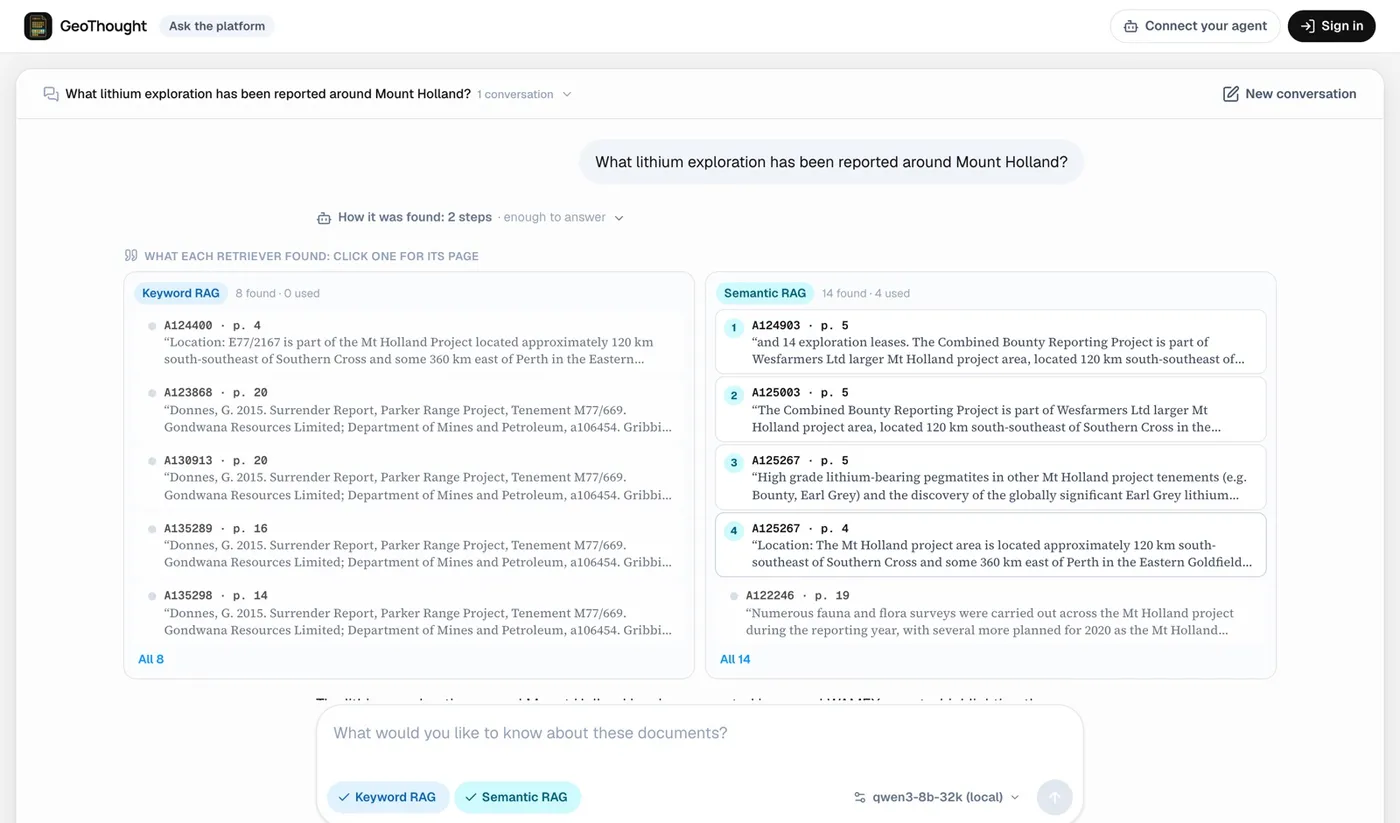
Ask about a tenement, a prospect or a unit. You get the reports that mention it, opened at the page, with the sentence highlighted. You read the original, not a rewrite of it.
“What did each company find here?”
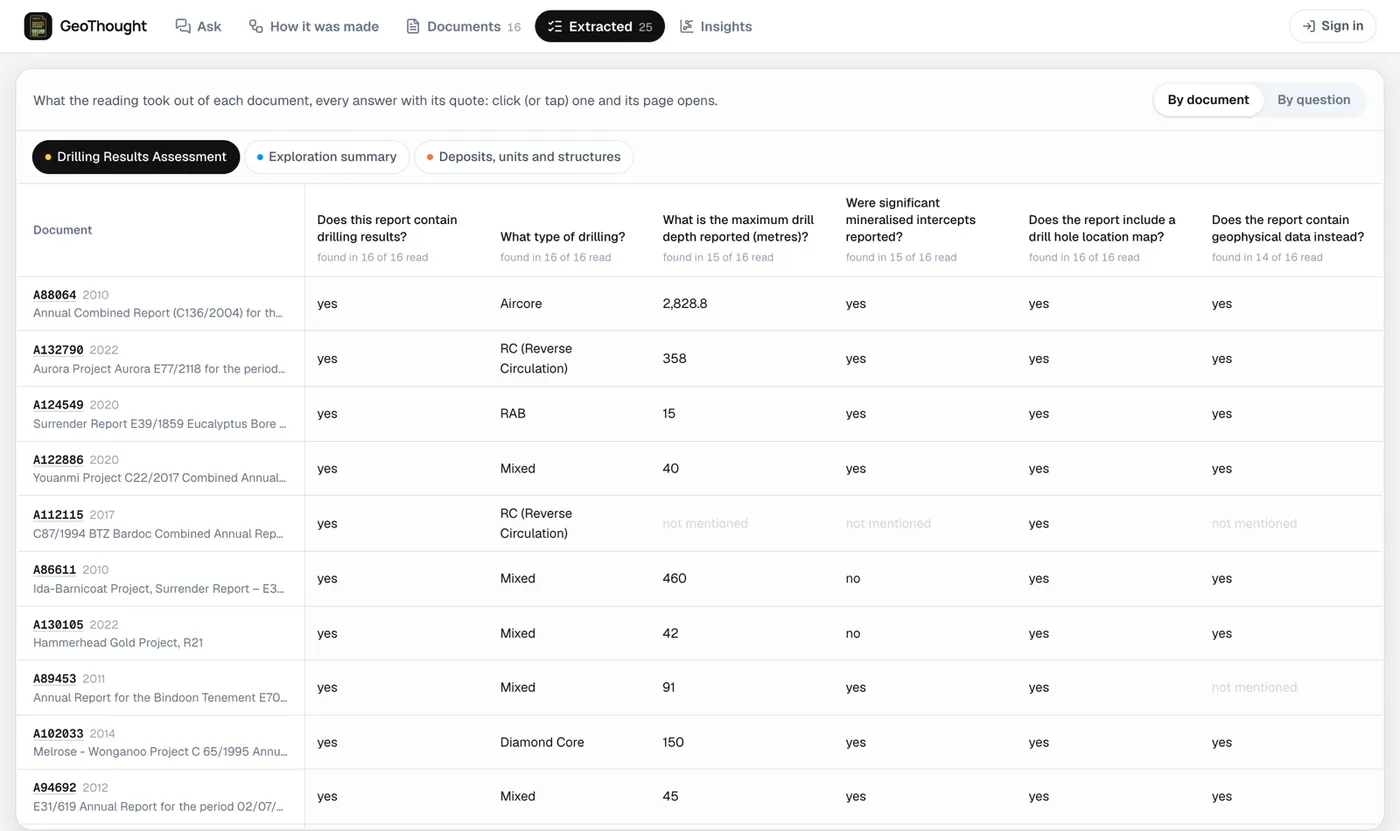
Write your questions once and every report on the area is answered in one table, a row per report, each answer linked to the page it came from.
“What has been published about this belt?”
Company reports, GSWA publications and research papers on the same ground come back in one list, each opened where it says so.
From a pile of reports to a table
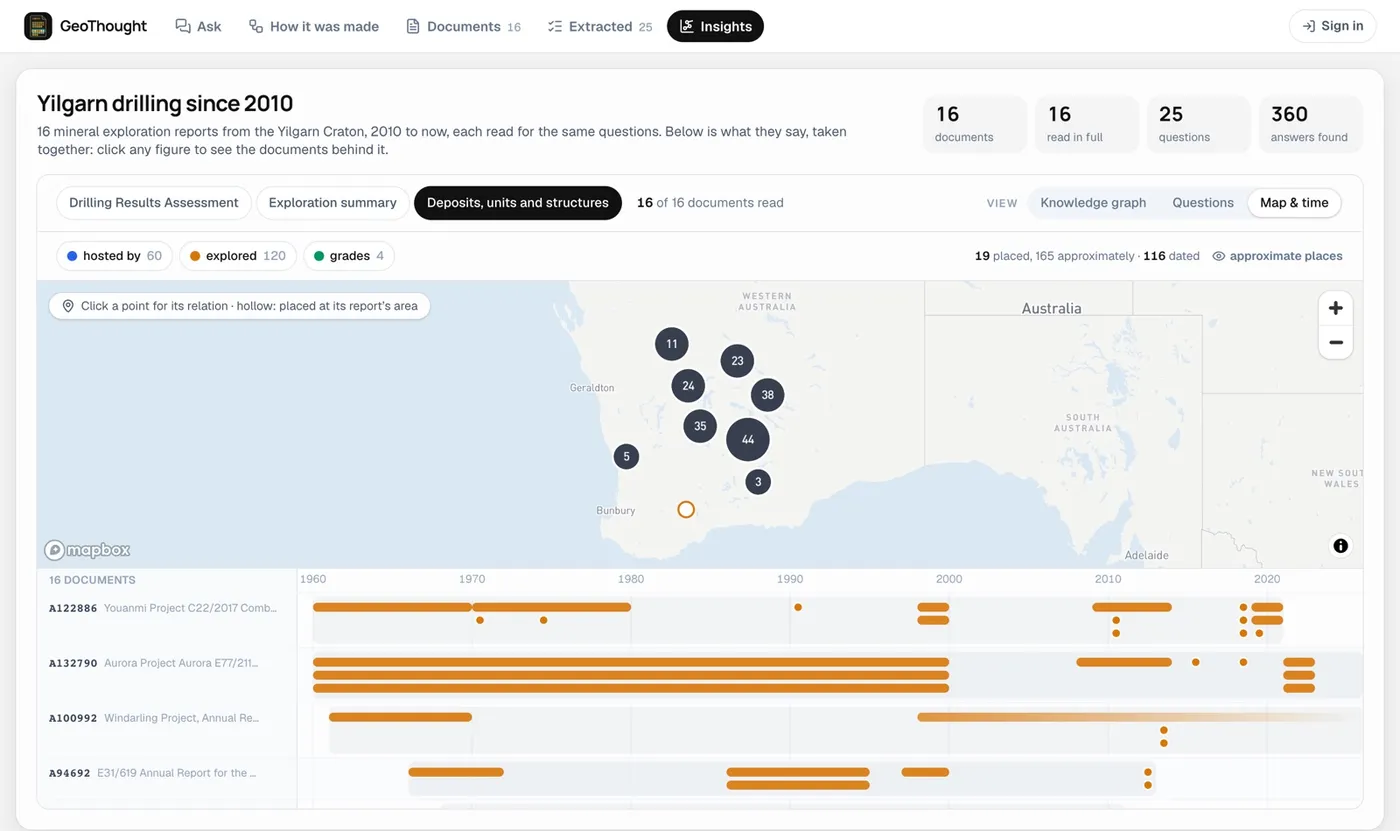
A real showcase project: 16 reports on the Yilgarn Craton since 2010, each read for the same 25 questions.
Traced to the page
Every answer shows where it came from
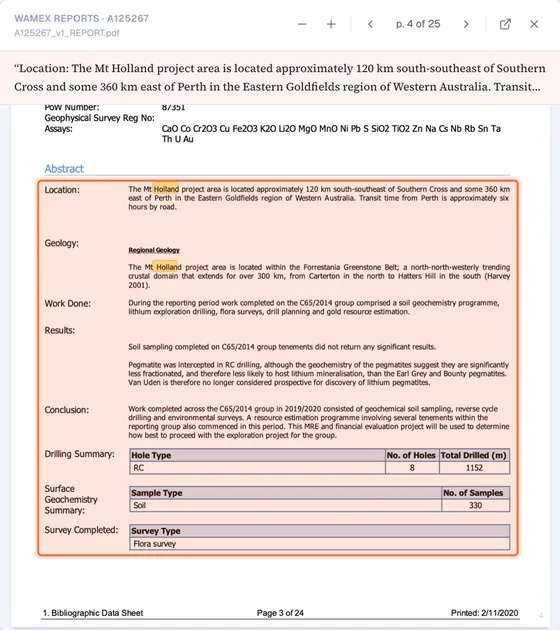
A geologist will not act on a number they can't check. So GeoThought never gives an answer without its source: the quote, the report, the page and the box on that page.
- Quote and page, every time. Each answer is stored with the sentence it rests on and where that sentence sits on the page.
- “Not mentioned” means read in full. An answer is only marked absent when every part of the report was read and none of it said so. It is an audited negative, not a missed search.
- Honest about limits. The model can misread, so the page is always one click away. Numbers inside appendix tables are not extracted yet, so drill results should be checked against the page.
Who it helps
GeoThought is free to search. The same method works on any archive of reports, contracts or records. More on AI document processing and search.
Explorers
Know who worked a tenement and what they found before you peg it or plan a drilling program.
Geological consultancies
Turn weeks of desktop study into a table of answers your geologists check, page by page.
Any business with an archive
Old reports, contracts and inspection records, read for the questions your team asks, each answer linked to its page.
Under the hood
Read once, answer many times
Each report is split into parts of about 3,000 characters. One model call per part answers the whole list of questions at once, and the answers are folded back into one answer per question, with its quote.
Answers are stored per question, not per project. A question someone has already asked of a report is never paid for twice, and rearranging answered questions into a new table costs nothing.
- Three ways to aska comparison table, facts and relations, or a decision path
- Questions find the reportsyour questions become searches across every corpus
- Read in parts~3,000 characters a call, the whole checklist at once
- Answers kept with quotesthe sentence and its box on the page
- Open to your own agent24 tools to search reports, open pages and query drilling and geochemistry
- Your documents tooupload your own, or run it on your own servers
Keen to have a chat?
Schedule a coffee chat in Perth, an online meeting or an in-person meeting at your office. A rough idea of what you'd like to improve is plenty.